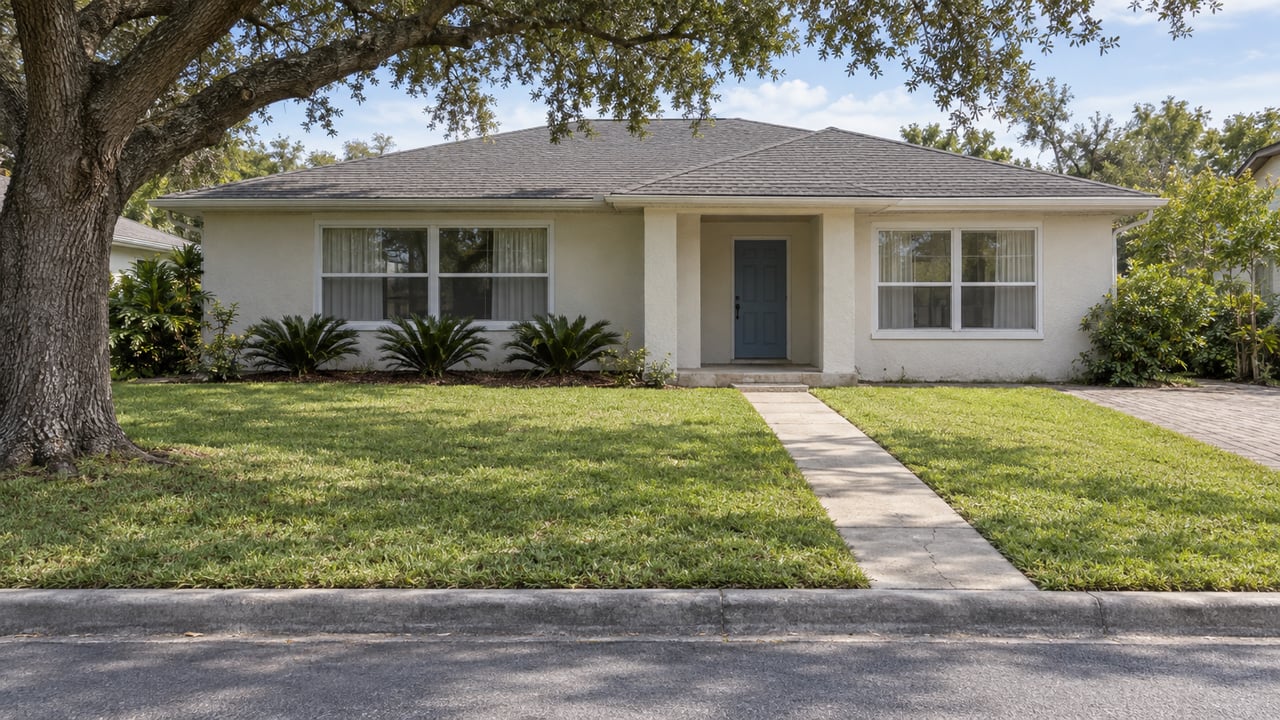
Allendale Terrace Parking in St. Petersburg: Why the Plan Stalled
October 15, 2026
October 15, 2026
"Unfortunately, to make parking abutting residential property more available to residents, employee overflow parking into neighborhoods may need to be reduced and is a tradeoff for consideration."
Evan Mory, St. Petersburg's Transportation & Parking Management Director, wrote that sentence in a memo to the city's Public Services and Infrastructure Committee before an April 2026 meeting, according to St. Pete Rising. Two months later, the ordinance built around that tradeoff reached City Council and went nowhere. For Allendale Terrace, one of the neighborhoods whose residents had raised the issue, the result is simple. The curb in front of your house still works the way it did before anyone proposed changing it, and the city had already said it couldn't enforce a change if one passed.
The Council of Neighborhood Associations defines Allendale Terrace as the area from the west side of 7th Street North to Dr. Martin Luther King Jr. Street North, between 34th and 38th Avenues North, plus Foster Hill Drive North. That puts the neighborhood's eastern edge right on MLK Street North, a corridor that has been adding destinations at a steady pace.
Just south of 34th Avenue, Aldi converted the former Winn-Dixie at 3327 Dr. Martin Luther King Jr. Street North. A few blocks further south, Golden Isles Brewing soft-opened at 3000 MLK Street North in October 2023. Below that, in the 2300 to 2600 blocks, sit Trip's Diner, Wildflower Ice Cream, and The Violet Stone, three businesses whose owners later spoke at the council hearing.
St. Pete Rising reported that residents along the 4th Street North and MLK Street North corridors, specifically naming Allendale Terrace, Crescent Heights, and Magnolia Heights, raised concerns about overflow parking "as commercial activity continues to expand in those areas." City staff described the same pattern across the whole city. In his memo, Mory wrote that "businesses continue to open and expand along various commercial corridors," while "neighborhoods continue to experience challenges with overflow customer and employee parking."
So the request from these neighborhoods was part of a citywide question, and the answer was supposed to be a citywide tool.
The proposal was Ordinance 638-H, which would have created Neighborhood Resident Only Parking Areas. It had its first reading at City Council on May 28, 2026, with a public hearing set for June 11, 2026. It would not have drawn any new zones by itself. It set out a process neighborhoods could use to petition for one. As reported by the St. Pete Catalyst and St. Pete Rising, the steps were:
The two tests measure different things. A street can be full because the people who live on it own a lot of cars, and the 75 percent test alone wouldn't separate that from a street filled by restaurant customers. The 25 percent test was there to show that outsiders were actually part of the pressure.
There was a geographic limit too. City staff said the ordinance already barred resident-only parking directly next to commercial properties. Council also discussed a buffer that would have kept permit areas at least one block from major commercial corridors. In a neighborhood whose eastern boundary is MLK Street North, a one-block buffer would have mattered. The homes closest to the corridor, which are the ones most likely to get overflow cars, are the ones a buffer would have left out.
The strongest objections at the June 11 hearing came from business owners on MLK Street North, south of Allendale Terrace. Their parking situations show why the debate was difficult.
| Business | Address | Background | Parking situation described at the hearing |
|---|---|---|---|
| Trip's Diner | 2339 Dr. MLK Jr. St N | Neighborhood staple for about 14 years | On-site lot behind the building holds about 10 to 15 cars |
| Wildflower Ice Cream | 2603 Dr. MLK Jr. St N | Grand opening in July 2025 | Owner asked for an economic impact study before any similar restrictions |
| The Violet Stone | 2609 Dr. MLK Jr. St N | Moved from Kenwood on July 30, 2025, into a dine-in space seating up to 100 | Pays other businesses to use their parking |
The Violet Stone shows the problem clearly. When it moved to MLK Street North in 2025, it went from its old space at 2134 9th Avenue North to a restaurant that seats up to 100. Co-owner Daniel Fekete told council, "I know at my spot, people are parking blocks away," and said the business couldn't survive only on customers who live close enough to walk. Phillip Ingram of Trip's Diner, whose lot holds 10 to 15 cars, warned that passing the ordinance without the buffer language could have "unintended disastrous consequences."
Steve McGarry of Wildflower Ice Cream gave the wider economic picture. "I think over the last two years we've all seen dozens of small businesses close," he said, pointing to rising rents, insurance, and health care costs. Chris Steinocher, president and CEO of the St. Petersburg Area Chamber of Commerce, called the proposal a "not in my front yard" approach to parking.
The Catalyst summed up both sides in two sentences. Homeowners want parking in front of their homes, and customers have to park somewhere. The corridor's commercial lots are small because, as several owners pointed out, many of these buildings went up before modern parking requirements existed.
Even if the ordinance had passed and an Allendale Terrace block had met both tests, a practical problem remained. City staff had already noted that St. Petersburg lacks the personnel and systems to enforce resident-only parking zones outside downtown and its nearby neighborhoods. Expanding enforcement would likely require more staff, vehicles, and administrative support.
That limit comes from how the existing program grew. According to Mory, St. Petersburg's residential permit parking program started in 1992 to deal with parking pressure in neighborhoods next to downtown. It later spread west and into Old Northeast, where permits limited parking by employees and visitors whose destinations were outside the neighborhood. Enforcement grew along the same path. A permit zone on 36th Avenue North would have been well outside it.
Timing added another complication. Only weeks earlier, council had approved the SunRunner Bus Rapid Transit Overlay, which removed minimum parking requirements for new development along much of the Central Avenue corridor west of 19th Street. That change applies to Central Avenue, not MLK Street North. Still, the Catalyst noted that critics of the SunRunner change worried it would push parking demand into surrounding neighborhoods, and that the resident-only ordinance was meant in part to give neighborhoods a way to respond. The city had just decided to require less parking from new buildings on one corridor. Then it was asked to let neighborhoods restrict who could use the street parking that remained.
On June 11, 2026, council heard the ordinance and declined to move it forward as written. No vote was taken. St. Pete Rising reported that the ordinance had "effectively reached the end of its current path forward," adding that it could return to committee but that there seemed to be little support for continuing the discussion. Councilmember Lisset Hanewicz called it "a good faith effort" to address a problem raised with her in various forms. Our research found no coverage after June showing that it has returned. As of today, the most accurate description is that the ordinance is stalled, not repealed and not scheduled.
For Allendale Terrace, here is what that means in practice:
If the proposal comes back to committee, it will most likely start from those same numbers, and from the same staff memo that called reduced employee and customer parking a tradeoff.
Curb parking rarely shows up on a listing sheet, but it's part of everyday life on a street, and it can matter when you're deciding between two homes a block apart near MLK Street North or 4th Street North. If you live in Allendale Terrace and want to talk through how corridor growth like this affects your home's position, or you're comparing blocks near the corridor, Abdiel Gil is glad to look at the specifics with you, in English or Spanish. Let's Connect.
This article is general information, not legal, tax or financial advice. Consult a qualified professional about your situation.
Stay up to date on the latest real estate trends.
Experience personalized guidance backed by years of industry knowledge and local expertise. From finding the right home to making confident financial decisions, every step is focused on your success.

Abdiel Gil
1155 Pasadena Ave S South Pasadena, FL 33707