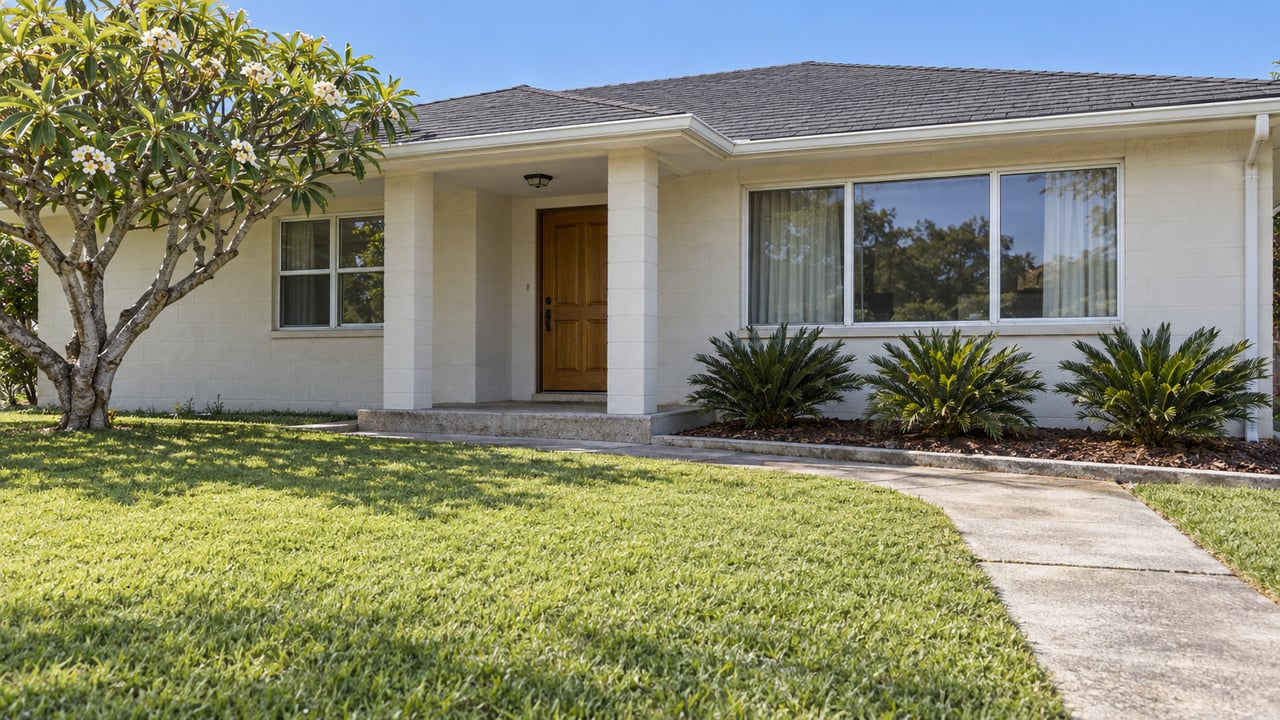
Eagle Crest Lake Gets Its Closest Care in the Fall, and a School Calendar Is Why
October 8, 2026
October 8, 2026
Eagle Crest Lake gets its most hands-on attention in the fall. The reason goes back to 1925, when the lake was dug to sell lots in a development that hardly sold any. Nearly a century later, the people who canoe it, pull trash out of it and test its water mostly arrive with the school year. If you walk the loop at 66th Street North and 6th Avenue North, this is the schedule your lake runs on.
St. Petersburg developer and historian Walter P. Fuller told the story in his 1954 book "This Was Florida's Boom." An excerpt is reproduced on the Eagle Crest neighborhood page. Fuller called Eagle Crest "the most complete capsule picture of the 1925 boom." The prices he records show why.
| Date | Transaction, per Fuller |
|---|---|
| Jan. 5, 1883 | Hamilton Disston acquires the 120 acres from the State of Florida at 25 cents an acre, $30 total |
| Nov. 15, 1885 | Disston sells 440 acres to Edwin F. Keen of Philadelphia at $5 an acre; most of Eagle Crest is later built on Keen's land |
| Feb. 5, 1925 | Dulwich Land Company buys the 120-acre tract for $120,000, about $1,000 an acre |
| Feb. 28, 1925 | Dulwich sells it 23 days later for $860,000 |
The last buyer, and the owner for the next quarter century, was Harry Eagle of New York, president of the Eagle Silk Co. Eagle's manager, John McBean, told Fuller that Eagle put about $3,000,000 into the project. Here is how Fuller described the work:
He dug lakes, brick paved every street and ran a five-foot pipeline to Boca Ciega Bay to carry off surface water.
The water features were meant to be part of the sale, the same as the brick streets. Fuller also writes that the city had grown uneasy about the improvement liens it had been guaranteeing. Starting with Eagle, it began requiring developers of outlying tracts to pay part of their improvement costs in cash. Fuller remembered the figure as 30 percent.
By the time Eagle's lots were ready, the boom was over. Fuller wrote that he doubted Eagle "sold a dozen lots." Eagle built a winter home on one of them and spent his winters there until he died.
So the lake outlasted the business plan behind it. It was built to make a new subdivision more appealing to buyers, and the buyers mostly came decades later. In the meantime the land around it changed hands, the neighborhood filled in, and a college campus went up beside it.
The city now runs the area as Eaglecrest Lake Park, spelled as one word on the Parks and Recreation page. The park is open from 30 minutes before sunrise until 30 minutes after sunset. It has a playground and sits next to the St. Petersburg Community Library and St. Petersburg College's Gibbs Campus. Stewards of Our Urban Lakes describes shaded benches and walking paths around the water, and mentions kayaking, fishing and shoreline walks.
Having the campus next door turned out to matter more than anything Eagle built.
In late fall 2023, St. Petersburg College was asked to join a community cleanup of Eagle Crest Lake's shoreline. According to the SPC newsroom, this is the stretch between the Joseph H. Lang Student Success Center and 66th Street. The volunteers were students from St. Petersburg Collegiate High School, which operates on the Gibbs Campus. They kept coming back, and cleaning the shoreline became a yearly fall project. The college says it has since become a main priority for the school's National Honor Society chapter.
Stewards of Our Urban Lakes, known as SoUL, gives the same start date. Its Eagle Crest page says SoUL and Keep Pinellas Beautiful worked with the college in 2023 to begin cleaning the lake, the campus grounds and the surrounding neighborhood. SoUL began in April 2007 with a wetland-planting grant at Crescent Lake and the Friends of Crescent Lake. It became a federal nonprofit in 2021 and then expanded to other city lakes. Environmental scientist Jim Bays chairs its volunteer board.
Each partner has its own role. Keep Pinellas Beautiful provides canoes, so volunteers can reach trash out on the water and not just along the bank. Students, faculty and neighbors clear litter from the lake, the campus and nearby streets. The City of St. Petersburg is a partner in organizing the events.
The cleanup is also classwork. Students work with Environmental Science Professor Dr. Stephanie Palomino, and SPC lists what they collect:
In 2024, students set up four test plots along the shoreline and planted five species of aquatic plants. As of the college's February 2025 report, the plots had thrived. The same report put the total trash removed at more than 1,000 pounds. That number is from early 2025 and does not include the cleanups since.
The college has not published the actual water-quality readings. The data exists, but there is no public scorecard yet showing how the lake is doing. What is public is the work itself: plots planted, trash weighed, species logged.
The trash connects to everyday habits on nearby streets. The city's stormwater guidance explains that St. Petersburg's storm drains empty into lakes, creeks, bays and the Gulf without treatment, and that fertilizer runoff can feed algae blooms. That guidance covers the whole city, not Eagle Crest Lake specifically. Still, it explains why SoUL's Eagle Crest volunteers work "the surrounding watershed" as well as the lake.
Eagle Crest Lake has a different setup from St. Pete's other urban lakes. SoUL holds monthly cleanups at Crescent Lake and Mirror Lake. At Eagle Crest, as at Round Lake, Meadowlawn, Jungle Lake and Lake Pasadena, SoUL helps out but does not run a monthly event. The program SPC describes is a yearly fall cleanup built around the student year.
The timeline so far:
The fall timing also lines up with the International Coastal Cleanup. The Eventbrite listing places SoUL's 2026 participation between Sept. 1 and Oct. 31. School is in session, the national cleanup season is underway, and volunteers are easier to find, so most of the lake's yearly care happens in the same few months.
If you want to be part of the November cleanup, the September event is a good guide. The St Pete Catalyst listing said volunteers met at the St. Petersburg College Gibbs Campus, 6606 5th Avenue North, where parking was available and carpooling was encouraged. Organizers supplied gloves, safety vests, trash bags, pickers, sunscreen and bug spray, and restrooms were on site. They recommended closed-toe shoes, a hat, sunglasses and a refillable water bottle. Volunteers under 18 had to be signed in by a parent or guardian, and anyone under 15 had to stay with an adult the whole time.
The Nov. 6 date comes from Eventbrite search results that don't print a year, and the event page says dates and times can vary. Confirm the date there before you go. SoUL's site also has the Eagle Crest program page and links to its partners.
Harry Eagle dug the lake to sell lots that never sold. The next cleanup listed on Eventbrite is a Friday morning in November, starting from the Gibbs Campus next to the lake.
If you're a neighbor curious about Eagle Crest's history, or about anything else on the west side of St. Pete, I'm happy to talk it through in English or Spanish. Reach out through Abdiel Gil and Let's Connect.
Stay up to date on the latest real estate trends.
Experience personalized guidance backed by years of industry knowledge and local expertise. From finding the right home to making confident financial decisions, every step is focused on your success.

Abdiel Gil
1155 Pasadena Ave S South Pasadena, FL 33707